OncoFlow
Replacing spreadsheets and paper trails in oncology wards with a unified clinical dashboard.
The Problem
Oncology pharmacists track chemotherapy cycles, lab results, drug interactions, and patient timelines — often across disconnected spreadsheets, paper forms, and hospital systems that don't talk to each other. A missed lab value or a scheduling conflict in a treatment cycle isn't just inefficiency — it's a patient safety risk. The existing workflow depends on manual cross-referencing and institutional memory rather than structured, accessible data.
The Solution
OncoFlow is a web-based clinical dashboard purpose-built for oncology pharmacists. It centralizes patient management into three core modules:
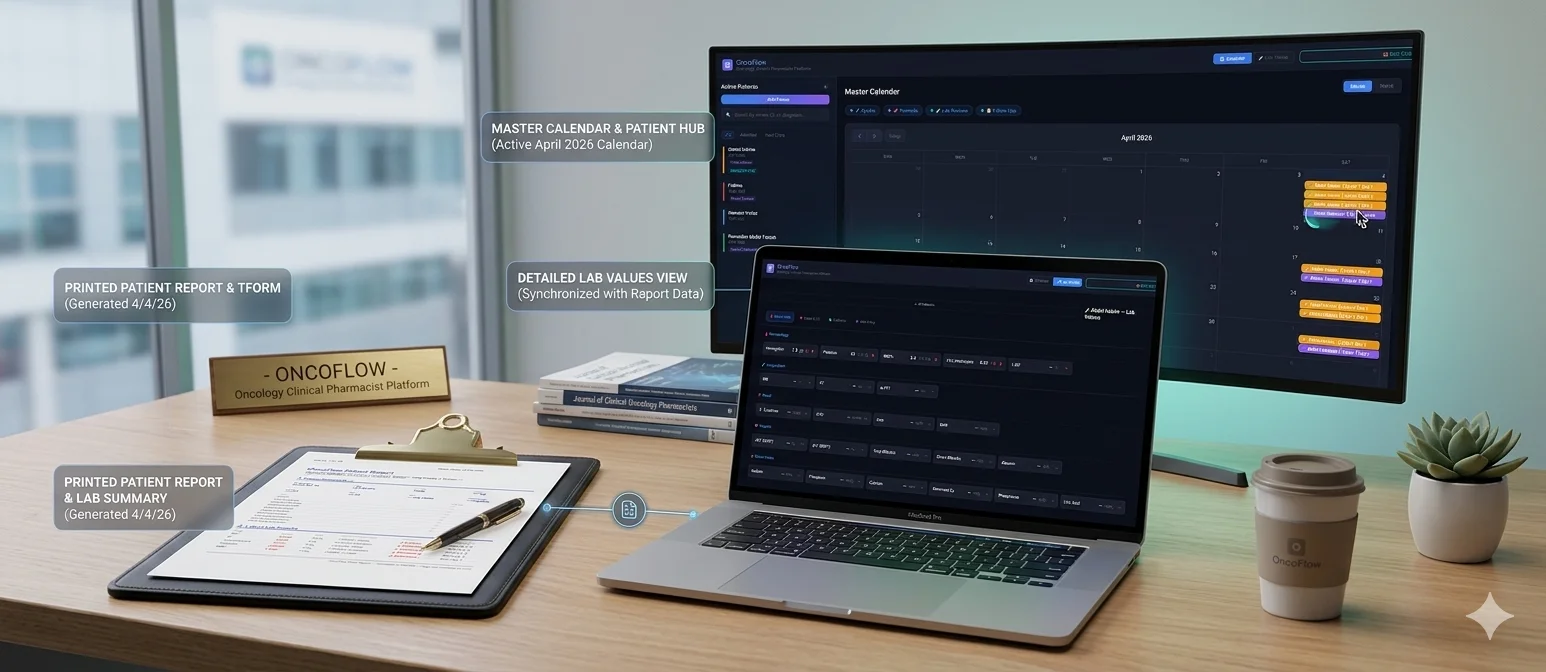
A Master Calendar that maps every patient's chemotherapy cycles, pre-medications, lab reviews, and follow-ups onto a single timeline — color-coded by event type, filterable by protocol. When a pharmacist assigns a treatment protocol to a patient, the system automatically generates the full cycle schedule, associated medications, expected symptoms, and treatment timeline — eliminating manual calendar entry and reducing scheduling errors.
A Lab Values Tracker organized by clinical category (hematology, renal, hepatic, coagulation, electrolytes) with historical trending and flag-worthy thresholds, so pharmacists can assess treatment readiness at a glance rather than digging through paper records.
A Patient Registry with search, protocol tagging (CHOP, FOLFOX, etc.), and admission tracking — giving pharmacists a structured, filterable view of their active caseload instead of a mental list.
The platform also generates printable patient reports and lab summaries — bridging the gap between the digital dashboard and the physical documentation that hospitals still require.
Technical Decisions
The stack is Next.js with Supabase for auth, database, and row-level security — chosen for rapid prototyping speed without sacrificing a real permission model. The calendar uses a custom implementation rather than a third-party library, allowing treatment cycle logic (21-day CHOP cycles, dose-day mapping) to be encoded directly into the scheduling layer. Supabase's real-time subscriptions keep the dashboard current across concurrent sessions.
Where it Stands
Built in collaboration with a clinical pharmacy graduate as a working prototype. Currently being refined for proposal to oncology departments and private clinics as a lightweight alternative to full-scale hospital information systems.
Altınkapı